What is the best neighbourhood to stay in Seville?
El Arenal. It sits between the cathedral and the river, three to seven minutes from everything you came to see, and it empties at night in a way Santa Cruz never does. Santa Cruz is the prettier postcard and the busier, pricier warren. Triana is the one to choose on a second visit. Avoid booking outside the old town to save money, because in this city walking distance is the whole product.
Seville areas at a glance
The best areas to stay in Seville, compared for vibe, price and who each suits.
| Area | Best for | Price | In a word |
|---|---|---|---|
| El Arenal | first timers, luxury | $$$ | Between the cathedral and the river, quiet at night |
| Santa Cruz | first timers, romance | $$$ | The postcard warren, and everybody knows it |
| Alfalfa | food, nightlife | $$ | Where the city eats, one street from the sights |
| Triana | food, budget | $$ | Across the river, and proud of not being the centre |
| Alameda de Hercules | nightlife, budget | $$ | Bohemian, young and cheaper, twenty minutes out |
| Santa Catalina and San Bartolome | romance, luxury | $$$ | Old town without the crowds |
| Nervion and Los Remedios | families, budget | $$ | Modern Seville, where the pools and the parking are |
- Free cancellation on most rooms
- No booking fee
- Prices on Trip.com
Best areas to stay in Seville
Ranked best-first, with the vibe, who it suits and an honest catch for each. Tap a filter to match an area to your trip.
Find your area - what matters most?
All 7 areas in Seville, best first.
 $$$ · High-end
El Arenal
Between the cathedral and the river, quiet at night
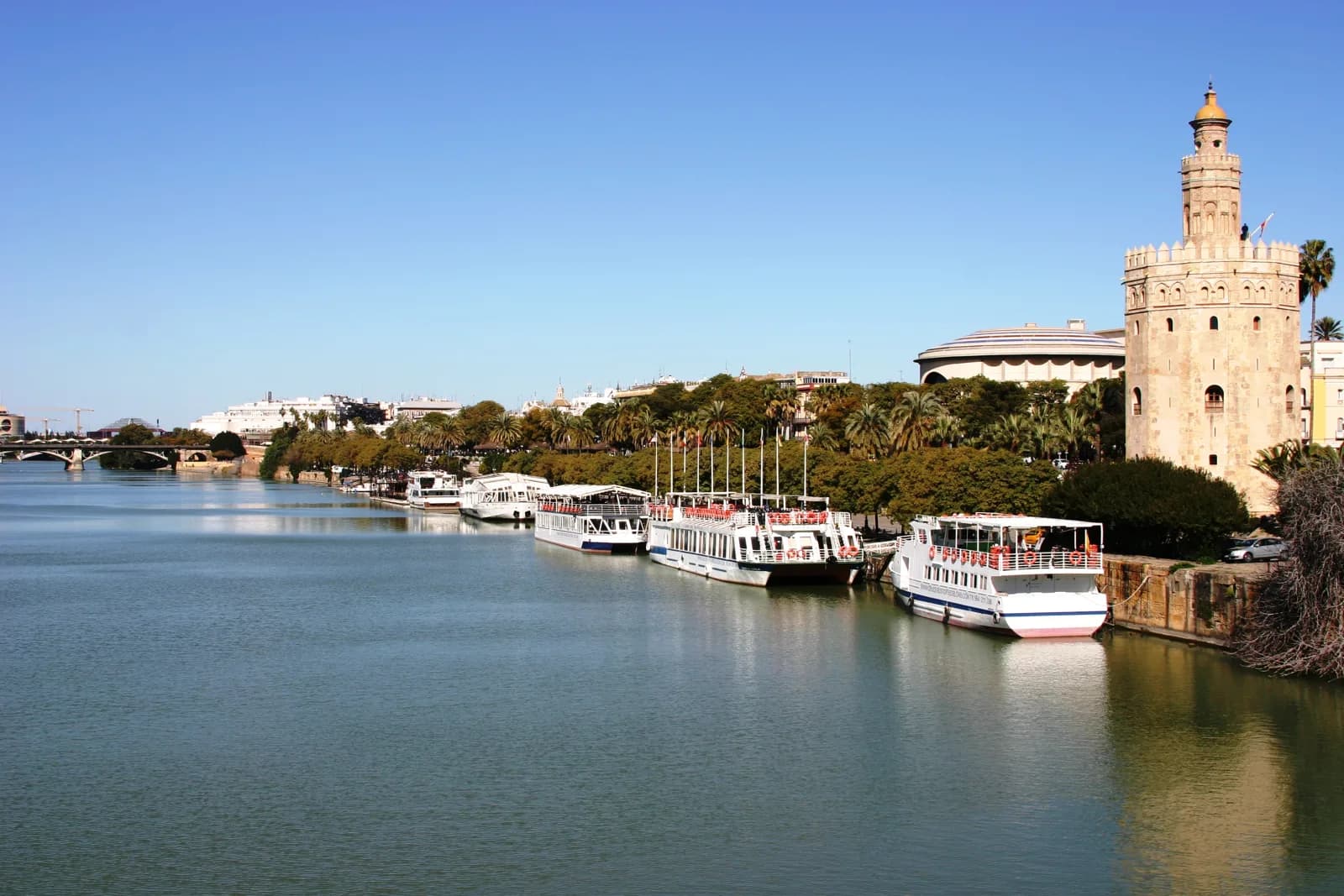
Best for:First-timersLuxuryFood & wineSightseeingThe old riverside quarter west of the cathedral, running from the Torre del Oro up to the bullring and the Plaza de Toros de la Maestranza. This was the port district when Seville held the monopoly on trade with the Americas, and it is now the most useful address in the city: the cathedral and the Alcazar are a three to seven minute walk, the river is at the end of the street, and the streets themselves are wide enough to find your way around. Its great advantage over Santa Cruz is what happens at night, when the day visitors drain east and the Arenal returns to being a neighbourhood with good tapas bars along Calle Garcia de Vinuesa and Calle Arfe.
Good to know: It is not cheap, and the stretch immediately around the bullring gets busy on fight days and during the Feria. The riverside itself is pleasant but the road along it carries traffic, so a room facing the Paseo de Cristobal Colon is louder than one a street back.
See El Arenal hotelsLive prices for your dates- Free cancellation on most rooms
- No booking fee
- Prices on Trip.com
 $$$ · High-end
Santa Cruz
The postcard warren, and everybody knows it
Best for:First-timersRomanceSightseeingThe old Jewish quarter immediately east of the cathedral, a lattice of whitewashed lanes, orange trees and hidden plazas that is genuinely as beautiful as the photographs. Everything is close: the cathedral, the Alcazar and the Archivo de Indias are all inside its western edge, and the hotels here are mostly converted casas palacio built around patios. If you have three days and want to walk out of your door into the sights, this is the obvious answer and it is a good one.
Good to know: Two honest drawbacks. The lanes are deliberately disorienting, laid out to confuse and to keep the sun out, and finding your hotel with luggage on arrival day is a real task; note the nearest plaza rather than the street name. And it is the most touristed ground in Seville, so the restaurants on the through-routes are priced for people who will not come back, while the bars two streets north in Alfalfa are better and cheaper.
See Santa Cruz hotelsLive prices for your dates- Free cancellation on most rooms
- No booking fee
- Prices on Trip.com
 $$ · Mid-range
Alfalfa
Where the city eats, one street from the sights
Best for:Food & wineNightlifeFirst-timersBudgetThe quarter immediately north of Santa Cruz, centred on Plaza de la Alfalfa. It is the same medieval street pattern without the tour groups, and it is where Sevillanos actually go out: a dense run of tapas bars around Calle Perez Galdos and Calle Boteros that fills late and stays cheerful. You are five to seven minutes from the cathedral, so you give up nothing on access, and you gain a neighbourhood that is still doing its own thing.
Good to know: It is loud. The bars around the plaza run until well past midnight at weekends, and the buildings are old with single glazing, so a front room facing a busy calle is a poor bet if you sleep early. Ask for interior or patio-facing.
See Alfalfa hotelsLive prices for your dates- Free cancellation on most rooms
- No booking fee
- Prices on Trip.com
 $$ · Mid-range
Triana
Across the river, and proud of not being the centre
Best for:Food & wineBudgetNightlifeRomanceThe barrio on the west bank, historically the quarter of sailors, potters and flamenco families, and still the part of Seville with the strongest sense of itself. The Puente de Isabel II drops you onto Calle San Jacinto, the market at Plaza del Altozano sits at the bridgehead, and the ceramics workshops that gave Triana its name still trade. Crossing the bridge at night with the cathedral lit behind you is the best free thing in the city, and prices fall noticeably the moment you are over the water.
Good to know: The river is a real boundary in practice as well as on the map: everything on the sightseeing list is a ten to twenty-minute walk away, over a bridge, in whatever the weather is doing. That is a pleasure in April and a decision in August. Calle Betis along the water is the loudest strip in Triana at weekends.
See Triana hotelsLive prices for your dates- Free cancellation on most rooms
- No booking fee
- Prices on Trip.com
 $$ · Mid-range
Alameda de Hercules
Bohemian, young and cheaper, twenty minutes out
Best for:NightlifeBudgetFood & wineA long tree-lined promenade north of the shopping streets, anchored by two Roman columns, that functions as the city's alternative living room. This is where the independent bars, the vermouth terraces and the late crowd are, and it is markedly younger and less polished than the old town. Rates are lower and the restaurants are aimed at residents, which shows on the bill.
Good to know: It is a genuine twenty-minute walk to the cathedral, which is the longest on this list, and the streets between here and the centre are ordinary commercial ones rather than scenic. The Alameda itself is busy and audible until very late at weekends, so pick a side street.
See Alameda de Hercules hotelsLive prices for your dates- Free cancellation on most rooms
- No booking fee
- Prices on Trip.com
 $$$ · High-end
Santa Catalina and San Bartolome
Old town without the crowds
Best for:RomanceLuxurySightseeingThe eastern half of the old town, quieter and less walked than Santa Cruz but built from the same fabric: narrow streets, palacios, churches, and some of the best-converted hotels in the city, including several of the grandest casa palacio conversions. You are eight to fourteen minutes from the cathedral, which in a city this flat is nothing, and you get the old town at a volume you can actually sleep in.
Good to know: The trade is convenience. You are on the far side of the old town from the cathedral, the Alcazar and the river, so every day starts with a walk rather than a step outside. There is also less to eat immediately around you than in Alfalfa.
See Santa Catalina and San Bartolome hotelsLive prices for your dates- Free cancellation on most rooms
- No booking fee
- Prices on Trip.com
 $$ · Mid-range
Nervion and Los Remedios
Modern Seville, where the pools and the parking are
Best for:FamiliesBudgetShoppingThe two twentieth-century districts, Nervion east of the old town and Los Remedios across the river beyond Triana. Neither is a tourist quarter and neither pretends to be: they are ordinary Spanish city neighbourhoods with wide streets, apartment blocks, chain shopping and the practical things the old town lacks, above all hotels with real ground-level swimming pools and somewhere to park a car.
Good to know: You are outside the walkable core, so plan on twenty-five minutes on foot or a short taxi to the cathedral, and there is no atmosphere to compensate on the walk. Los Remedios is also the Feria ground, so during the Feria de Abril it goes from the quietest option here to the busiest.
See Nervion and Los Remedios hotelsLive prices for your dates- Free cancellation on most rooms
- No booking fee
- Prices on Trip.com
Safest area to stay in Seville
El Arenal, Santa Cruz and Santa Catalina are the calmest places to sleep in Seville, which is a comfort ranking rather than a warning list: Seville is a safe city by European standards and no part of the old town is somewhere a visitor should avoid. The real risks here are heat and pickpockets, in that order.
El Arenal is residential enough to be quiet after the day crowds leave, well lit along the river, and busy with locals eating rather than with nightlife.
Santa Cruz is small, enclosed and heavily walked at all hours, which makes it feel secure even when its lanes are empty.
Santa Catalina is old town without the tourist churn, so the people on the street at night are mostly the people who live there.
The genuine hazard in Seville is the sun, not crime. The average daily maximum is 36.4 degrees in July and August on the 1991 to 2020 normals, the old town has almost no shade in its wider streets, and every summer visitors underestimate a twenty-minute midday walk that would be unremarkable anywhere else. Carry water, move like the locals by going out early and again after eight, and treat the middle of the day as indoor time. The crime that does affect visitors is opportunistic: bag snatching and pickpocketing in the cathedral queue, around the Plaza de Espana and on the crowded lanes of Santa Cruz, plus the rosemary-sprig routine outside the cathedral where a woman presses a sprig on you and then demands payment. None of it tracks the barrio you booked; it tracks the crowd.
Where not to stay in Seville
There is nowhere in Seville a visitor needs to avoid on safety grounds, so the booking mistakes are the ones worth naming. The biggest is choosing a modern district to save money. Nervion and Los Remedios are perfectly pleasant and perhaps twenty euro a night cheaper, and what they cost you is the thing you came for: Seville is a walking city whose pleasure is stepping out of a door into a lane, and a twenty-five minute walk down a boulevard each morning is a poor trade for that. If money is tight, cross the river to Triana rather than moving to a modern quarter, because Triana is cheaper, more characterful and still walkable. The second mistake is booking deep inside Santa Cruz without noticing what the lanes are: they were built to disorient, they are barely wide enough for two people, and arriving there with a large suitcase after dark is genuinely difficult, so note the nearest plaza before you travel. The third is the calendar rather than the map. Semana Santa and the Feria de Abril fall within a fortnight of each other in spring, and during Semana Santa the processions physically close the centre for hours at a time, so a hotel on the wrong side of a route can leave you unable to reach it. If you are visiting then, ask the hotel which streets are affected rather than assuming a central address helps.
Getting around Seville
You walk. The old town is roughly two kilometres across, it is entirely flat, and almost all of it is pedestrianised or too narrow for cars, so every barrio on this list is inside a twenty-minute walk of the cathedral. That is the single most important fact about staying here, and it is why paying for a central room is worth more in Seville than in most cities. What transport exists fills the gaps: a single tram line, the T1, runs a short route from Plaza Nueva past the cathedral to San Bernardo, useful for reaching the station end and little else; one metro line, Line 1, crosses the river and serves Nervion and the outer districts rather than the old town; and a dense bus network covers everywhere the other two do not. The bike-share, Sevici, suits a flat city very well and the riverside path is the best ride in it. Taxis are plentiful and cheap by northern European standards, and in July and August they are not an indulgence but the sensible way to cross the centre in the middle of the day. From the airport, the EA airport bus runs to the centre in about 35 minutes; from Santa Justa station, the old town is a 25-minute walk or a short taxi.
Where to stay in Seville: FAQ
The questions travelers ask most when choosing an area.
Plan the rest of the trip
Where to stay in other cities
Continue Planning Your Trip
Intelligent tools designed to simplify the complex.
Things to Do
Ranked attractions, tips and how to book tickets
Where to Stay
The best area to stay in each city, by neighborhood
Car Rental
Real prices, driving tips and the best routes by destination
Airport Transfers
Getting from the airport to your hotel, by price and time
All-Inclusive Guides
What all-inclusive really means, by destination
Best Time to Visit
Month-by-month weather, crowds and prices
Cheapest Places to Travel
18 destinations ranked by real daily budgets
Route Finder
Find the cheapest way to get there
Hotel Finder
Book the right hotel for your destination
AI Trip Planner
Build a day-by-day itinerary
Budget Calculator
Estimate total cost
Photo credits (7)
Photos via Wikimedia Commons, used under their respective licences.
- El Arenal: Feranza - CC BY-SA 3.0 · source
- Santa Cruz: Heinz Joerg Kretschmer - CC BY 3.0 · source
- Alfalfa: erikccooper - CC BY 2.0 · source
- Triana: Diego Delso - CC BY-SA 4.0 · source
- Alameda de Hercules: Gzzz - CC BY-SA 3.0 · source
- Santa Catalina and San Bartolome: Zarateman - CC0 · source
- Nervion and Los Remedios: CarlosVdeHabsburgo - CC BY-SA 4.0 · source