
The short answer
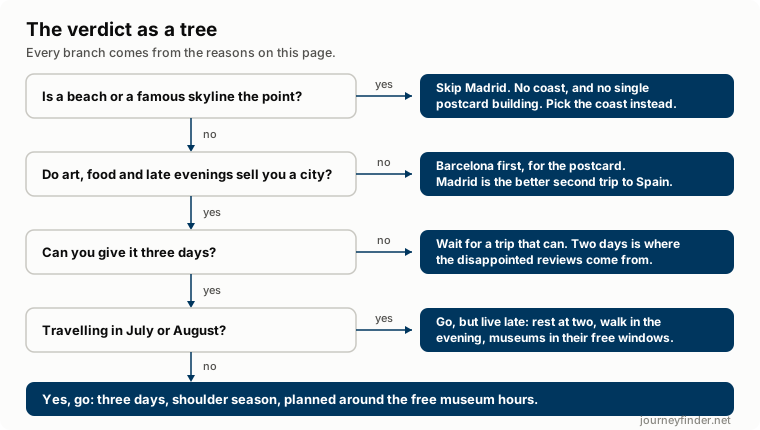
Yes, Madrid is worth visiting, with one condition: come for the art, the food and the street life, not for a skyline or a beach. It has no coast, no Gaudí and no single building people cross Europe to photograph. What it has instead is three of the best art museums on earth within ten minutes of each other, a food culture that outruns Barcelona, and a centre you can walk end to end. If your mental image of Spain is a beach, book somewhere else and enjoy it more.
Is Madrid worth visiting?
Yes, if you want art, food and a city that stays out late. The Prado, Reina Sofia and Thyssen sit within a ten-minute walk of each other and all three are free in the evenings. Madrid is the wrong choice if you want a beach, a famous skyline, or to visit in July and August when the interior regularly tops 35 degrees.
Why Madrid is worth it
The art is the reason, and the evenings are free
The Prado, the Reina Sofia and the Thyssen-Bornemisza sit on one boulevard within a ten-minute walk. Between them they hold Las Meninas, Guernica and eight centuries of European painting. Every one of them opens its doors free of charge for the last stretch of the day, so a serious art trip here costs nothing if you plan around the clock rather than the ticket desk.
It eats better than its reputation
Madrid has no coastline and still runs one of the best seafood scenes in Spain, because the country's catch has been trucked to its markets overnight for centuries. Add the tapas streets around La Latina, the century-old tabernas near Plaza Mayor, and a market culture that has not yet been entirely handed over to visitors.
The centre is genuinely walkable
Almost everything a first visit wants sits inside a two-kilometre circle. From Puerta del Sol it is five minutes on foot to the first hotels, nine to Gran Via, and a flat twelve to the Prado. The city sits at 660 metres but the centre itself is close to level, so the walking is easy in a way Lisbon's or Porto's is not.
Two of Spain's best day trips are under 90 minutes away
Segovia and Toledo are both close enough to leave after breakfast and be back for dinner, and both are UNESCO-listed. Segovia's aqueduct has stood without mortar since Roman times. That turns a three-day city break into something with more range than the map suggests.
It is cheaper than the obvious alternative
Madrid is not a budget city, but it is consistently less expensive than Barcelona for a hotel of the same standard in an equally central spot, and it has none of the cruise-ship surge that hits the coast in summer.
The city runs late, and that is not a cliche
Dinner at ten is normal rather than daring, and the bars around Malasana and Chueca fill after midnight on weeknights. If you like a city that is still awake when you are, this is the one in Spain that reliably is.
Why it might not be
The honest case against, so you can rule it out cheaply rather than expensively.
There is no beach, and it is not close to one
Madrid sits in the middle of the peninsula. The nearest coast is several hours away in any direction. If the trip you are picturing involves sea, this is the wrong city and no amount of rooftop pool makes up for it.
July and August are genuinely punishing
Our Spain guide puts the interior, Madrid included, at 35 to 40 degrees in high summer, and names July and August as the window to avoid. The city also half-shuts in August as Madrilenos leave, so you get the heat and a thinner version of the place at once.
No single sight will carry your camera roll
Barcelona has the Sagrada Familia, Granada has the Alhambra, Seville has the cathedral. Madrid's pleasures add up rather than announce themselves, which is exactly why it underperforms on a shortlist drawn up from photographs.
Two days is not enough, and people keep trying
The museums alone will take most of a day each if you do them properly. Madrid punishes the 48-hour stopover more than most European capitals, and a lot of the people who come away unimpressed came for two nights.
Madrid or Barcelona?
This is the question underneath the question. Most people weighing up Madrid are really choosing between Madrid and Barcelona, so here is the straight comparison rather than a diplomatic one.
| Madrid | Barcelona | Winner | |
|---|---|---|---|
| Art museums | Three world-class museums within a ten-minute walk, all free in the evenings | Strong modern collections, Picasso and Miro, but nothing on the Prado's level | Madrid, comfortably |
| Architecture | Handsome rather than astonishing. Grand boulevards, no single landmark | The Sagrada Familia and Park Guell. Buildings people fly in specifically to see | Barcelona, and it is not close |
| Beach | None. The nearest coast is hours away | City beaches you can reach on the metro | Barcelona |
| Food | Deeper tapas culture, better markets, and the country's catch arrives here overnight | Excellent, but the centre has been more thoroughly rebuilt around visitors | Madrid |
| Crowds and cost | Busy, but no cruise surge. Cheaper for an equivalent central hotel | Among the most heavily visited cities in Europe, and priced that way in season | Madrid |
| Summer weather | 35 to 40 degrees inland in July and August, and the city empties | Hot but coastal, with sea breeze and somewhere to swim | Barcelona |
| Day trips | Segovia and Toledo, both UNESCO-listed, both under 90 minutes | Girona and Montserrat, good but a longer haul from the centre | Madrid |
If it is your first trip to Spain and you want the postcard, go to Barcelona. If you have been to Barcelona, or you care more about what you eat and what hangs on the walls than what you photograph, Madrid is the better week. In high summer, take Barcelona regardless: the coast is the deciding factor when it is 38 degrees.
- Free cancellation on most rooms
- No booking fee
- Prices on Trip.com
Who should go, and who should not
Go if
- Anyone who would plan a day around a painting
- Repeat visitors to Spain who have already done the coast
- Eaters, especially anyone who thinks they know Spanish food from the coast
- Travellers who want a walkable centre without hills
- People who like late cities and late dinners
Book elsewhere if
- Anyone whose picture of Spain includes a beach
- A two-night stopover, which is too short to do the museums justice
- July and August visitors who cannot start early and rest at midday
- Anyone travelling for architecture rather than art
When to go
April to June and September to October, which is the window our Spain guide names for the whole country and which fits Madrid especially well: warm days, cool evenings, and the museums without the summer queues. November is an underrated month here, quiet and clear and cheap. Skip July and August if you have any choice, because the interior tops 35 degrees and much of the city leaves. Winter is cold for Spain but it is bright, and city-break prices are the lowest of the year.
Is Madrid worth visiting: FAQ
The questions people ask before they book.
If you decide to go
Continue Planning Your Trip
Intelligent tools designed to simplify the complex.
Things to Do
Ranked attractions, tips and how to book tickets
Where to Stay
The best area to stay in each city, by neighborhood
Car Rental
Real prices, driving tips and the best routes by destination
Airport Transfers
Getting from the airport to your hotel, by price and time
All-Inclusive Guides
What all-inclusive really means, by destination
Best Time to Visit
Month-by-month weather, crowds and prices
Cheapest Places to Travel
18 destinations ranked by real daily budgets
Route Finder
Find the cheapest way to get there
Hotel Finder
Book the right hotel for your destination
AI Trip Planner
Build a day-by-day itinerary
Budget Calculator
Estimate total cost