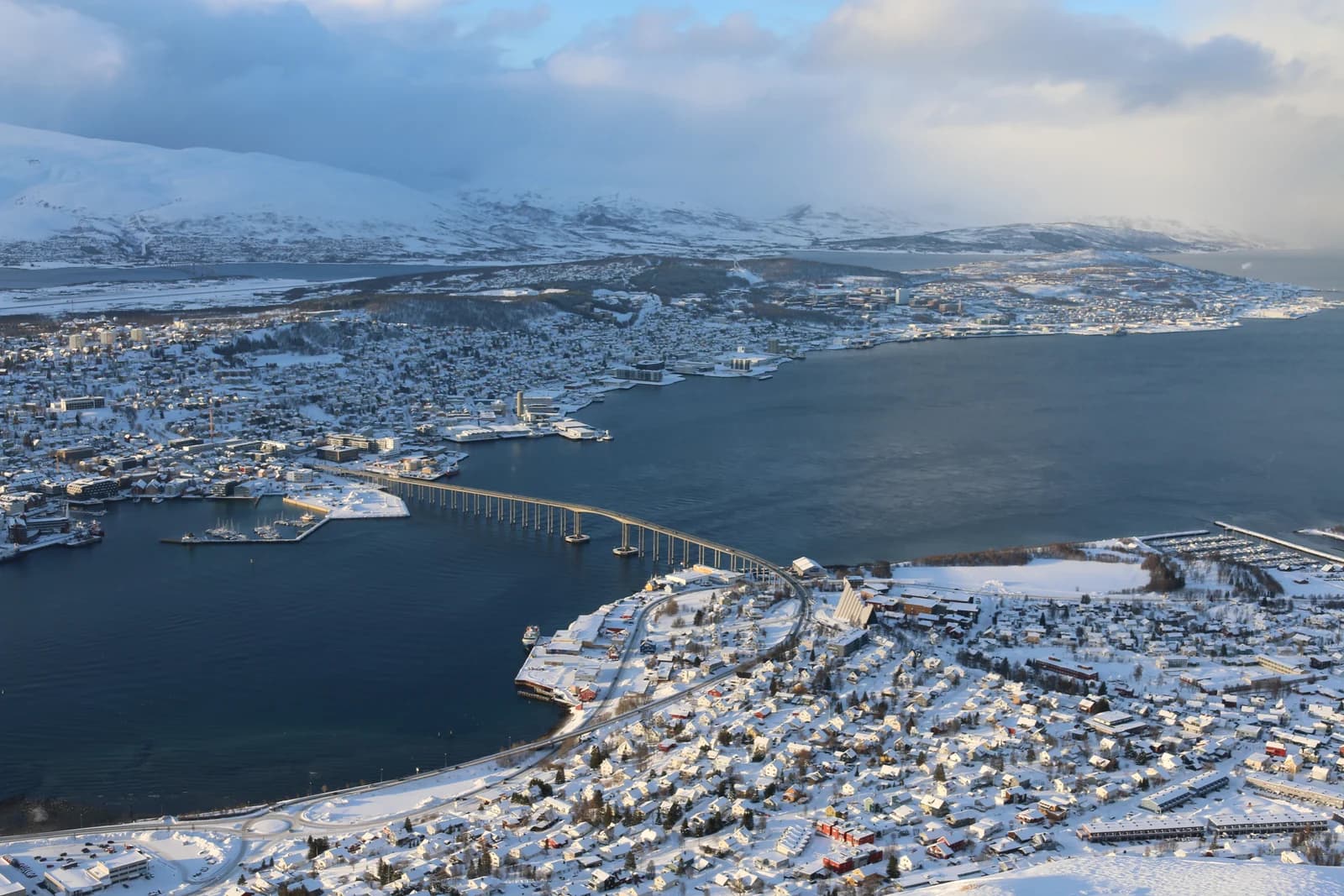
In Brief
Can you see the Northern Lights in Tromso in January?
Yes, January offers dependable darkness for viewing the northern lights in Tromso. Even on 31 January, civil twilight ends at 15:50 and does not resume until 08:02 the next morning, leaving 16 h 12 min of darkness. The peak auroral window between 20:00 and 02:00 sits entirely inside full darkness.
Key takeaways
- The sun rises on 15 January 2027 at 11:35 for 37 minutes, ending 48 days of polar night.
- Daylight expands rapidly from 37 minutes on 15 January to 4 h 55 min on 31 January.
- The primary auroral viewing window of 20:00 to 02:00 falls inside complete darkness on every night of January.
- NOAA airport observations show 47 per cent of January evenings have a clear sky window of 0 to 2 oktas.
- The yr.no January normal mean temperature is minus 3.0 C, though January 2026 averaged minus 6.2 C.
Pick your budget
Budget
Thermal suit single-item rental
Tromso Outdoor Thermal Suit
Daily rental of an insulated thermal suit at NOK 190.00 per day from the town centre shop.
- Most popular
Mid-range
Standard Arctic clothing package
Tromso Outdoor Arctic Package
Full four-piece kit including thermal suit, Cauck or Kamik winter boots, hat, and mittens for NOK 350.00 per day.
Splurge
Exclusive down clothing package
Tromso Outdoor Exclusive Package
Premium two-piece down jacket and insulated trousers set with boots, hat, and mittens for NOK 480.00 per day.
Tromso in January: the month the sun comes back
January is the only month in Tromso that begins in complete polar night and ends with almost five hours of direct sun. For the first fourteen days of the month, the sun remains entirely below the horizon. The turning point arrives mid-month, transforming the visual landscape of northern Norway within a fortnight.
Two independent astronomical authorities agree on the exact date of the sun's return. The Norwegian Meteorological Institute's Sunrise 3.0 API and the US Naval Observatory's one-day sun data both calculate 15 January 2027 as the first sunrise, occurring at 11:35. The sun dips below the horizon just 37 minutes later, at 12:12 according to MET Norway and 12:13 according to the US Naval Observatory.
Daylight accumulates at a remarkable speed following that first appearance. By 31 January, sunrise occurs at 09:30 and sunset at 14:25, providing 4 h 55 min of sun above the horizon. That represents a gain of 4 h 18 min in only sixteen days, adding roughly a quarter of an hour of sun each day. Solar noon shifts by just ten minutes across the entire month, from 11:47 on 1 January to 11:57 on 31 January, meaning daylight expands equally at both ends of the day.
Visitors should note that the town's local celebration does not match the astronomical date. Visit Tromso lists the annual sun-return party on 21 January, when locals eat traditional sun buns (solboller) and drink hot chocolate. Because Tromso is encircled by steep mountain ridges, the physical disc clears the horizon six days before its rays clear the peaks to illuminate the town streets.
- First astronomical sunrise occurs on 15 January 2027 at 11:35, lasting 37 minutes.
- Daylight expands from 37 minutes on 15 January to 4 h 55 min on 31 January.
- The town gains 4 h 18 min of sun across sixteen days, averaging around 15 minutes gained per day.
- Tromso celebrates the sun's return on 21 January due to the surrounding mountain ridges blocking early rays.
The catch: The surrounding mountain topography blocks direct sunlight from reaching town-centre streets until 21 January, nearly a week after the astronomical sunrise.
Polar night in Tromso in January: the exact day it ends
The polar night in Tromso encompasses 48 consecutive days, spanning from 28 November 2026 to 14 January 2027. Fourteen of those polar night days fall squarely in January. On each day from 1 to 14 January, MET Norway's Sunrise 3.0 API reports no sunrise and no sunset for Tromso coordinates (69.6492 N, 18.9553 E), while the US Naval Observatory marks the sun as continuously below the horizon.
Polar night does not equate to pitch darkness at midday. The solar disc climbs steadily closer to the horizon as January progresses. On 1 January, the centre of the sun's disc sits 2.65 degrees below the horizon at solar noon. It rises to 2.26 degrees below on 5 January, 1.61 degrees below on 10 January, and 0.95 degrees below on 14 January. Because civil twilight extends until the sun is 6 degrees below the horizon, Tromso experiences soft twilight around midday even in early January.
Refraction creates a curious astronomical technicality on 15 January. On that date, MET Norway flags the sun as visible at solar noon despite the disc centre remaining 0.77 degrees below the horizon. The upper limb of the sun clears the horizon line once atmospheric refraction and the radius of the solar disc are factored in. The first day the centre of the disc itself climbs above the horizon at solar noon is 19 January, reaching plus 0.02 degrees.
Different sources present slightly varying definitions of this period. Visit Tromso describes the polar night descriptively as lasting from late November to mid-January. A local accommodation operator, Glass Cabins, defines the window between 27 November and 15 January. MET Norway and US Naval Observatory coordinates confirm 14 January as the final full day below the horizon.
- The polar night spans 48 days overall, concluding on 14 January 2027.
- Midday solar elevation improves from minus 2.65 degrees on 1 January to minus 0.95 degrees on 14 January.
- Atmospheric refraction makes the upper limb visible on 15 January while the disc centre is minus 0.77 degrees.
- The centre of the solar disc first clears the horizon on 19 January at plus 0.02 degrees.
The catch: During the first fourteen days of January, the sun never clears the horizon, restricting outdoor sight-seeing to brief windows of midday twilight.
Tromso January daylight, day by day
Daylight duration in Tromso shifts more drastically during January than in almost any other winter travel destination. From 1 to 14 January, direct sunlight remains at zero minutes. Following the 37-minute sunrise on 15 January, sun above the horizon jumps to 1 h 15 min on 16 January, 2 h 36 min on 20 January, 3 h 45 min on 25 January, and 4 h 55 min by 31 January.
Civil twilight provides practical light long before sunrise and long after sunset. On 1 January, civil twilight begins at 09:27 and ends at 14:08, offering 4 h 41 min of usable ambient light without any direct sun. By 31 January, civil twilight spans from 08:06 to 15:50, delivering 7 h 44 min of usable light for outdoor activities.
This daylight curve dictates how visitors should structure their days. In the first half of January, daytime outdoor activities like snowshoeing or fjord tours must operate within the compact 10:00 to 14:00 window. By late January, travellers can complete a full five-hour daylight tour and still have several hours to rest before evening aurora excursions begin.
- Direct daylight increases from 0 minutes on 14 January to 295 minutes on 31 January.
- Usable civil twilight expands from 4 h 41 min on 1 January to 7 h 44 min on 31 January.
- Civil twilight begins at 09:27 on 1 January and advances to 08:06 by 31 January.
- US Naval Observatory and MET Norway calculations match within a single minute across the entire month.
The catch: Early January trips allow only about four hours of dim twilight for sightseeing, requiring tight scheduling for outdoor tours.
Tromso January northern lights: does the returning sun cost you dark hours?
A common concern is whether the return of daylight in late January reduces opportunities to view the aurora borealis. Astronomical records show that it does not cut into active viewing hours. On the night of 1 to 2 January, civil twilight ends at 14:08 and resumes at 09:26 the next morning, yielding 19 h 18 min of darkness. On the night of 31 January to 1 February, darkness spans 15:50 to 08:02, providing 16 h 12 min.
While January loses 3 h 06 min of total darkness over the month, none of that loss impacts the core aurora window. Both Visit Tromso and the Norwegian Centre for Space Weather (NOSWE) identify the peak aurora window as approximately 20:00 to 02:00. On every single night of January, that six-hour window sits deep inside complete darkness. At solar midnight, the sun sits 43.39 degrees below the horizon on 1 January and remains 37.87 degrees below on 31 January.
Cloud cover, rather than daylight, is what determines northern lights success in January. Analysis of seven years of NOAA hourly station data at Tromso Airport Langnes shows that 47 per cent of January evenings have at least one clear window of 0 to 2 oktas between 18:00 and 01:00. Furthermore, 57 per cent of evenings record 4 oktas or less, while 30 per cent remain overcast at 7 oktas or more. January ranks third best of the seven-month aurora season, outperforming February's 33 per cent clear evenings.
Scientific agencies publish no specific planetary Kp threshold for Tromso. The Norwegian Centre for Space Weather notes that local auroral displays in northern Norway frequently occur under low global Kp values. NOSWE states that statistically some form of aurora appears over Tromso on every other night, while Tromso Geophysical Observatory describes displays occurring on every other clear night or even more frequently.
- Usable night darkness ranges from 19 h 18 min on 1 January to 16 h 12 min on 31 January.
- The peak viewing window of 20:00 to 02:00 falls entirely inside complete darkness every night of the month.
- NOAA data reveals 47 per cent of January evenings feature a clear sky window of 0 to 2 oktas.
- January carries the season's highest share of sky-obscured cloud readings at 14.0 per cent, largely due to falling snow.
The catch: January records the highest proportion of sky-obscured cloud observations of the entire aurora season at 14.0 per cent, primarily caused by coastal snowfall.
Tromso January weather: the normals, and what last January actually did
Official climate statistics from yr.no, operated by the Norwegian Meteorological Institute and NRK, report a January normal mean temperature of minus 3.0 C and normal monthly precipitation of 108.0 mm at the Tromso Vervarslinga station. Coastal proximity to the Norwegian Sea moderates conditions, preventing the extreme sub-zero readings found further inland.
Daily climate normals indicate that the month grows colder as it progresses. The daily normal mean temperature starts at minus 2.5 C on 1 January, falls to minus 3.0 C on 15 January, and reaches minus 3.3 C on 31 January. According to these normals, late January and early February represent the coldest phase of the Tromso winter rather than the December solstice.
Actual observations from January 2026 illustrate how sharp winter deviations can be. During that month, the mean temperature registered minus 6.2 C, running 3.2 C colder than normal. Precipitation reached 58.2 mm across 11 precipitation days, roughly half the 30-year normal. Temperatures spanned from a low of minus 14.8 C on 1 January to a peak of plus 3.6 C on 18 January.
Ground conditions remained consistently wintry throughout January 2026, with snow depth recorded on all 31 days. Depths fluctuated between a minimum of 51 cm on 21 January and a peak of 83 cm on 27 January. High winds also featured, with the month's strongest gust reaching 17.9 m/s on 13 January alongside a mean wind speed of 10.6 m/s.
- The yr.no January climate normal is minus 3.0 C with 108.0 mm of precipitation.
- Observed January 2026 temperatures averaged minus 6.2 C, dipping to a low of minus 14.8 C.
- Snow lay on the ground on all 31 days of January 2026, measuring between 51 cm and 83 cm deep.
- Peak wind gusts in January 2026 reached 17.9 m/s at the Vervarslinga weather station.
The catch: Temperatures can fluctuate above freezing, as seen with plus 3.6 C in January 2026, causing wet snow and slush on town streets.
What to wear in Tromso in January, and what it costs to hire
Dressing for Tromso in January requires technical layering rather than a single bulky coat. Visit Tromso advises starting with woollen base layers directly against the skin, topped with warm, dry jumpers and insulated outerwear. Visitors should remove layers during strenuous activity to avoid sweat buildup and add them immediately when stationary.
The tourism board recommends preparing for a temperature range of minus 25 C to plus 5 C when participating in Arctic tours or watching for the northern lights. Because aurora chasing involves standing motionless outdoors for extended periods, extremities cool rapidly. Footwear must be sized generously enough to fit thick woollen socks without pinching circulation, and hand warmers are recommended for gloves and boots.
Travellers do not need to purchase expensive polar gear in advance. Tromso Outdoor, located at Fredrik Langes gate 14 in the centre, rents complete winter kits and individual items with daily hours from 10:00 to 17:00. A standard unisex Arctic clothing package costs NOK 350.00 per day and includes an insulated thermal suit, winter boots, mittens, and a hat with ear flaps. The Exclusive Arctic Clothing Package costs NOK 480.00 per day, featuring a down jacket, insulated trousers, winter boots, mittens, and a hat.
Individual items can also be hired separately. Adult thermal suits cost NOK 190.00 per day, winter jackets NOK 230.00, insulated trousers NOK 155.00, and winter boots NOK 160.00 (children under 16 pay NOK 130.00, 150.00, 105.00, and 110.00 respectively). Tromso Outdoor specifies that one rental day spans up to 24 hours and requires a refundable deposit of NOK 500 per person reserved at collection. For footwear, the shop recommends Kamik boots for walking and snowshoeing, and heavier Cauck boots for static aurora chases.
- Full Arctic clothing packages rent for NOK 350.00 per day at Tromso Outdoor in the town centre.
- Exclusive down jacket and insulated trouser packages cost NOK 480.00 per day.
- Single-item rentals range from NOK 155.00 for trousers to NOK 230.00 for adult jackets.
- A safety deposit of NOK 500 per person is reserved at pick-up, with multiday discounts applied automatically.
The catch: Tromso Outdoor closes at 17:00, requiring gear pick-up well before evening northern lights departures, and the basic suit is priced per day, at NOK 350, with the operator publishing multiday discounts but no multiday total.
Whale watching in January: the last month of the season
January marks the final opportunity of the winter season to see migrating whales in northern Norway. Arctic Explorers schedules its whale watching season from 17 October to 31 January, running tours in small groups of up to 12 guests. Tour rates start from NOK 2,900.00 per person for self-transfer packages meeting directly in Skjervoy, and from NOK 3,500.00 per person for RIB excursions.
Visit Tromso describes the general whale watching window as lasting from roughly mid-November to late January, noting that precise dates shift annually as herring schools migrate. Humpback whales, killer whales (orcas), and minke whales congregate in the fjords to feed on herring before heading into open ocean waters. By February, whale watching disappears entirely from Visit Tromso's activity schedule.
The excursions do not operate directly out of Tromso harbour. The feeding grounds are located in the archipelago surrounding Skjervoy, situated well north of the city. Reaching the boats requires an early morning road transfer or a dedicated passenger boat journey before boarding the whale watching vessels.
- Whale watching tours conclude on 31 January, marking the definitive end of the winter season.
- Arctic Explorers offers small-group tours from NOK 2,900.00 meeting in Skjervoy and NOK 3,500.00 for RIB trips.
- Target species include orcas, humpback whales, and minke whales following herring shoals.
- Tours operate out of Skjervoy, requiring a substantial road or boat transfer from Tromso.
The catch: Tours in early January run in dim twilight with no direct sunlight on the water, and tours operate out of Skjervoy rather than Tromso itself.
What is actually on in Tromso in January
January hosts several distinct cultural and sporting events. On 9 January 2027, Tromso stages the annual Polar Night Marathon. The event includes four race distances: the Ishavskraft Marathon, the Polar Night Half Marathon, Morketidsmila (10 km), and Morketidstrimen (5 km). Because 9 January falls within the polar night, competitors complete the entire course under twilight and darkness without a sunrise.
The Tromso International Film Festival (TIFF) takes place from 18 to 24 January 2027. Screening across venues in town, the festival coincides with the week the sun first reappears over the horizon. Soon after, on 21 January, the town observes its sun-return celebration, marked by hot chocolate and sun buns across local cafes.
Travellers frequently confuse January dates with major events scheduled for February. The Northern Lights Festival (Nordlysfestivalen) runs from 11 to 20 February 2027, according to the festival's official schedule. While Visit Tromso notes the festival loosely as occurring in late January or early February, the organiser's confirmed dates sit entirely in mid-February.
Sami National Day is celebrated on 6 February, established by the Sami Conference in 1992 to mark the first 1917 assembly in Trondheim. Tromso's annual Sami Week, which features reindeer racing down the high street and the national lassoing championship, takes place in February around this national holiday. However, Sami cultural reindeer-camp excursions operate daily throughout January, running across their full seasonal window of October to March.
- The Polar Night Marathon takes place on 9 January 2027 across four race distances.
- Tromso International Film Festival runs from 18 to 24 January 2027.
- Tromso's public sun-return celebration occurs on 21 January.
- The Northern Lights Festival (11 to 20 February) and Sami Week (February) do not take place in January.
The catch: Major headline winter cultural events such as the Northern Lights Festival and downtown reindeer racing take place in February rather than January.
Essential Tromso winter gear and activity prices in January
Every figure comes directly from published hire and operator rate sheets in Tromso for the winter season.
| Item | Price | Source | Check prices |
|---|---|---|---|
| Arctic clothing package hire (thermal suit, boots, hat, mittens per day) | NOK 350.00 | Tromso Outdoor rental tariff | Tours |
| Exclusive Arctic clothing package hire (down jacket, insulated pants, boots, hat, mittens per day) | NOK 480.00 | Tromso Outdoor rental tariff | Tours |
| Adult winter boots hire (per day) | NOK 160.00 | Tromso Outdoor rental tariff | Tours |
| Adult thermal suit hire (per day) | NOK 190.00 | Tromso Outdoor rental tariff | Tours |
| Whale watching tour with self-transfer to Skjervoy | From NOK 2,900.00 | Arctic Explorers tariff | Tours |
| Whale watching RIB tour from Skjervoy | From NOK 3,500.00 | Arctic Explorers tariff | Tours |
A safety deposit of NOK 500 per person is reserved at pick-up for clothing rentals at Tromso Outdoor. Multiday discounts apply automatically.
Where to stay in Tromso in January
Staying in Tromso town centre gives you immediate walking access to tour departures, clothing hire shops, and transport links without contending with icy roads in the dark. Fredrik Langes gate and the surrounding harbourfront put you steps from morning excursion pickups and evening aurora buses.
- Free cancellation on most rooms
- No booking fee
- Prices on Trip.com
How these facts were checked
Norwegian Meteorological Institute Sunrise 3.0 API, yr.no climate tables, and NOAA NCEI surface records
Tromso: your questions
The questions people ask before booking.
Continue Planning Your Trip
Things to Do
Ranked attractions, tips and how to book tickets
Where to Stay
The best area to stay in each city, by neighborhood
Car Rental
Real prices, driving tips and the best routes by destination
Airport Transfers
Getting from the airport to your hotel, by price and time
All-Inclusive Guides
What all-inclusive really means, by destination
Best Time to Visit
Month-by-month weather, crowds and prices
Route Finder
Find the cheapest way to get there
Hotel Finder
Book the right hotel for your destination
AI Trip Planner
Build a day-by-day itinerary