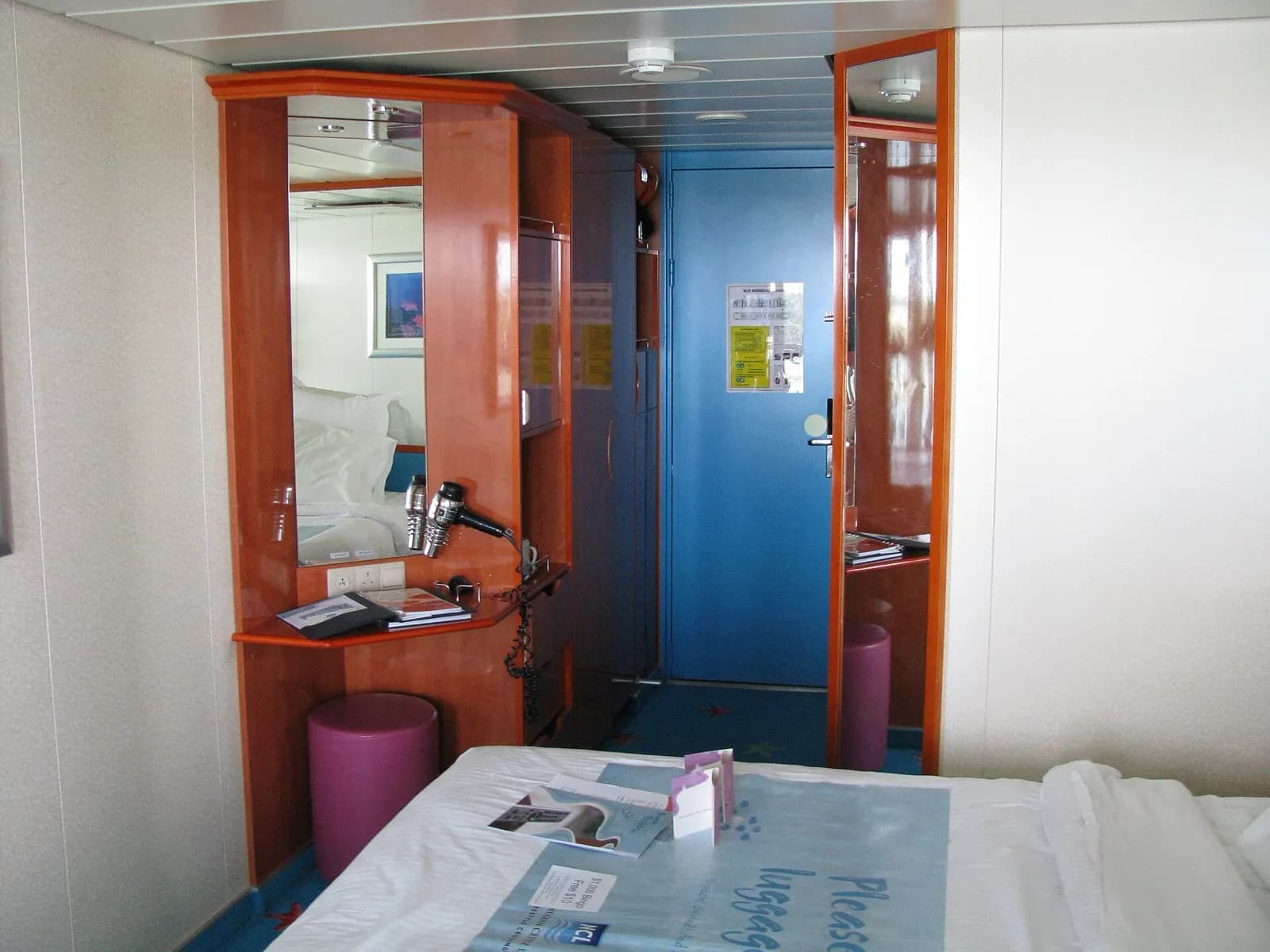
What is the best cabin location on a cruise ship?
The best cabin location on a cruise ship is midship on a middle deck - it moves least in rough seas, it is a short walk to most public areas, and it sits away from the noise sources at either end. If seasickness is your concern, go midship and low. If you want the biggest balcony, go aft. Always check the deck plan for what sits directly above and below your cabin, because that is what decides how quiet your week is.
- Free cancellation on most rooms
- No booking fee
- Prices on Trip.com
Cabin locations compared
Where the cabin sits matters more than the category badge on it. This is what each position actually gives you.
| Location | Best for | The trade-off |
|---|---|---|
| Midship, middle deck | Almost everyone | Least motion, shortest walk to everything, quietest. The default correct answer, and it sells out first. |
| Midship, low deck | Seasickness sufferers | The steadiest spot on the ship. No view worth having if it is an oceanview, and further from the pool deck. |
| Aft (rear) | Balcony size and wake views | Often much larger balconies and a beautiful wake view, but more vibration from the engines and a long walk forward. |
| Forward (front) | Cheaper fares, big sea views | The most motion of any position, plus wind noise and anchor noise early in port mornings. |
| Under the pool deck | Nothing | Scraping loungers from dawn, foot traffic and music. The single most common regret on any sailing. |
| Above the theatre or club | Nothing | Bass carries upward through the floor until late. Check the deck plan for what is beneath you. |
How to read a deck plan before you book
The single most useful thing you can do is open the ship's deck plan and look at the decks directly above and below your cabin, not just your own. A cabin can be perfectly placed midship and still be ruined by what sits overhead. Pool decks, buffets, the theatre, nightclubs, the gym and crew service areas are the usual culprits, and none of them are flagged when you pick a room.
Look for cabins sandwiched between other cabin decks - that is the quietest arrangement available, because passengers on both sides are sleeping when you are. Also check for the small unmarked rooms on the plan near your cabin, which are often crew doors, laundries or service lifts, and they open and close at all hours.
The other thing to check is whether your balcony is genuinely private. On many ships the balconies on the highest cabin deck are overlooked from public decks above, and some aft and corner cabins have partial partitions. If you booked a balcony for privacy rather than air, this is worth two minutes on the plan.
- check_circleCheck the decks above and below your cabin, not just your own.
- check_circleCabins sandwiched between other cabin decks are the quietest.
- check_circleWatch for unmarked service rooms, crew doors and laundries on the plan.
- check_circleOn the top cabin deck, check whether your balcony is overlooked from above.
Which cabin type is worth the money
Interior cabins are the best value in cruising on a port-heavy itinerary. You are ashore all day and asleep at night, and the money saved covers several excursions. The one genuine drawback is that they are pitch dark with no natural light, so people oversleep - set an alarm, and expect to lose your sense of time.
Oceanview cabins, with a sealed window, are often barely cheaper than a balcony and are the weakest value in the range. If you are choosing between oceanview and interior, take the interior and save the money. If you are choosing between oceanview and balcony, the balcony is usually worth the small step up.
Balconies earn their price on scenic itineraries and long sea days - Alaska, the Norwegian fjords, Antarctica, transatlantic crossings - where you will genuinely sit out there. On a warm Caribbean run with short hops and full days ashore, many people find they barely use it. Suites buy space and perks rather than a better position, and a well-placed balcony often beats a badly placed suite.
- check_circleInterior on a port-heavy itinerary: best value, but genuinely pitch dark - set an alarm.
- check_circleOceanview is usually poor value - take the interior or step up to a balcony.
- check_circleBalconies pay off on scenic and sea-day-heavy routes, less so on busy Caribbean itineraries.
- check_circleA well-placed balcony beats a badly placed suite.
Cabins to avoid on any ship
Directly beneath the pool deck is the classic mistake. Loungers get dragged across the deck from around 6am, and there is nothing between that and your ceiling. Beneath or above the buffet is similar, with trolleys and early setup. Above the theatre or a nightclub means bass through the floor until late.
Forward cabins on low decks hear the anchor and the bow thrusters, which fire early on port mornings and are genuinely loud. Cabins beside lift shafts and stairwells get constant passing traffic and chatter. Cabins near crew access doors get the doors themselves, which are heavy and rarely closed gently at 3am.
One more that is easy to miss: connecting cabins. The interconnecting door has a much poorer sound seal than a wall, so you hear your neighbours clearly. Unless you are travelling as a group and want the connection, avoid them - they are marked on the deck plan with a small linking symbol.
- check_circleUnder the pool deck or the buffet - noise from around 6am.
- check_circleAbove the theatre or nightclub - bass carries through the floor.
- check_circleForward and low - anchor and bow thruster noise on port mornings.
- check_circleConnecting cabins - the interconnecting door transmits sound far more than a wall.
If you are prone to seasickness
Book midship and as low as you can afford. A ship pivots around its centre of gravity, so the middle of the vessel moves least and the bow and stern move most - the difference between a forward high cabin and a midship low one is substantial in real seas. This choice matters more than any remedy you can take.
A window or balcony helps more than people expect, because seeing the horizon lets your inner ear and eyes agree with each other. An interior cabin removes that reference entirely, which is why interior cabins feel worse in rough water even though they are often positioned well.
Route matters too. The Caribbean, the Alaskan Inside Passage and the summer Mediterranean are mostly sheltered and calm. The Drake Passage to Antarctica, the Bay of Biscay, transatlantic crossings and the North Sea in shoulder season are the stretches that move. Match the cabin to the route rather than treating every sailing the same.
- check_circleMidship and low is the steadiest position on any ship.
- check_circleA window or balcony gives you a horizon, which genuinely helps - interiors feel worse.
- check_circleTake medication before sailing rather than after symptoms start.
- check_circleMatch the cabin choice to the route; sheltered itineraries barely move at all.
Frequently asked questions
- Free cancellation on most rooms
- No booking fee
- Prices on Trip.com
More cruise guides
First time cruise tips
What to expect on your first cruise: embarkation day, the muster drill, cruise etiquette and dress code, how to avoid seasickness, and what not to bring on a cruise.
Cheapest time to cruise
The cheapest time to cruise, month by month, when cruise prices drop, how much to tip, how much cash to bring, and the booking moves that cut hundreds off a sailing.
Continue Planning Your Trip
Intelligent tools designed to simplify the complex.
Things to Do
Ranked attractions, tips and how to book tickets
Where to Stay
The best area to stay in each city, by neighborhood
Car Rental
Real prices, driving tips and the best routes by destination
Airport Transfers
Getting from the airport to your hotel, by price and time
All-Inclusive Guides
What all-inclusive really means, by destination
Best Time to Visit
Month-by-month weather, crowds and prices
Cheapest Places to Travel
18 destinations ranked by real daily budgets
Route Finder
Find the cheapest way to get there
Hotel Finder
Book the right hotel for your destination
AI Trip Planner
Build a day-by-day itinerary
Budget Calculator
Estimate total cost