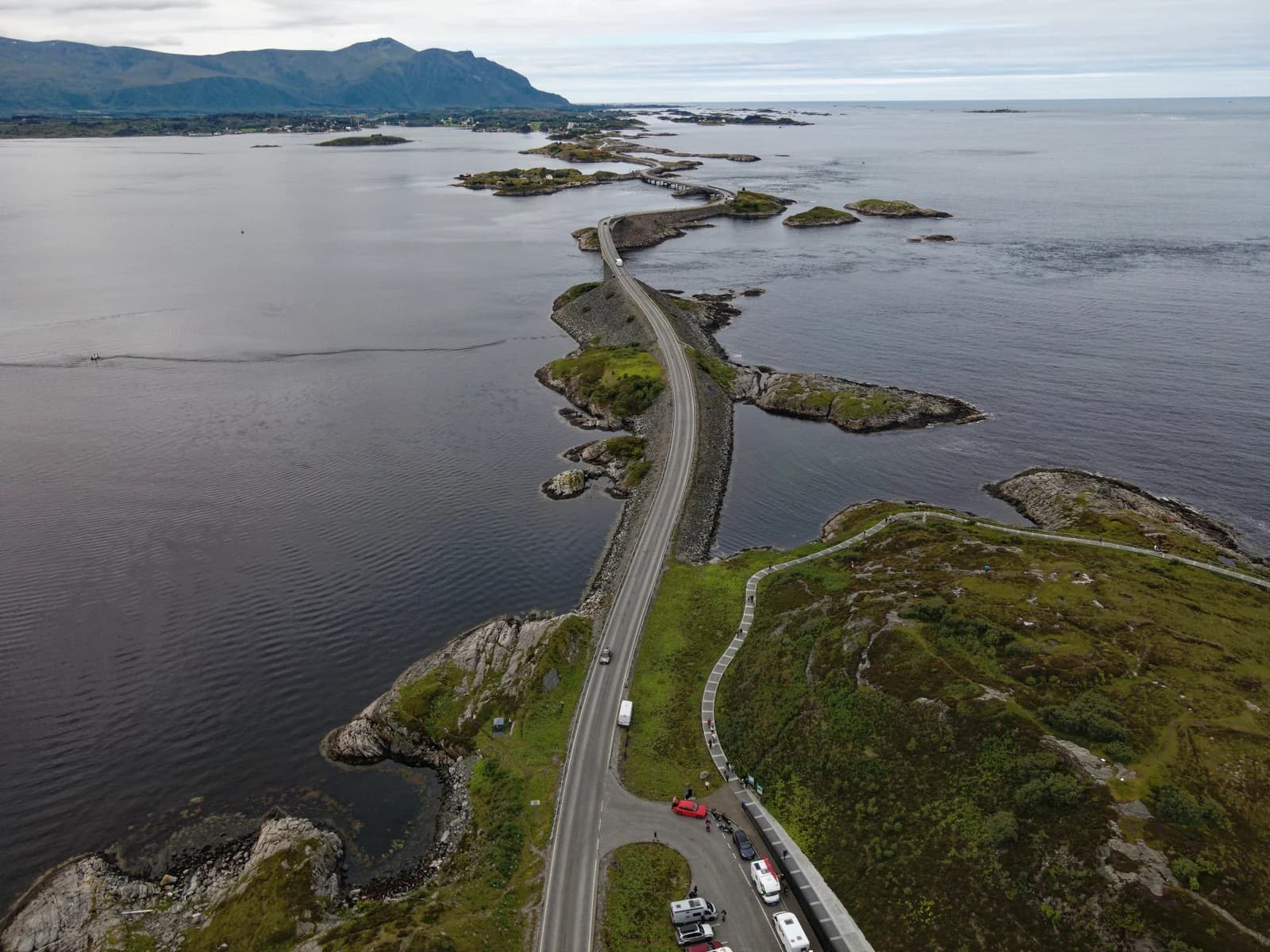
In Brief
Is it worth renting a car in Norway?
Renting a car in Norway is worth it if you plan to explore remote fjords, scenic mountain passes, or chase the northern lights in Arctic regions. For city stays strictly in Oslo or Bergen, public transport avoids steep toll rings, high parking fees, and complex winter driving regulations.
Key takeaways
- Winter tyre tread depth of 3 mm is mandatory from 1 November in the south, but starts 16 October in northern counties.
- Oslo toll gantries charge up to NOK 50 for diesel cars during peak hours across three municipal rings.
- Statens vegvesen monitors 108 weather-exposed road stretches, with 13 fixed convoy routes located entirely in Finnmark.
- A credit card in the primary driver's name is standard, with security authorisations starting from NOK 1,000 to NOK 3,000.
NOK 399/day
economy class, before extras
- Free cancellation on most cars
- Compare every supplier at once
How much does car rental cost in Norway?
Rough daily prices by car type. Rates rise in peak season - book early for the best deal.
| Car type | Price / day | Good to know |
|---|---|---|
| Toyota Aygo X (small city car) | NOK 399/day | Standard rate via Hyre in Oslo; includes 150 km daily allowance with additional distance at NOK 3 per km. |
| Renault 5 (electric city car) | NOK 799/day | Electric hatchback rate via Hyre; lowers to NOK 599 with Hyre Pass Plus subscription. |
| Toyota bZ4X (electric SUV) | NOK 969/day | Hyre electric SUV offering extra ground clearance; subscription rate is NOK 899 per day. |
| Skoda Octavia (family car) | NOK 999/day | Standard family estate rate via Hyre; lowers to NOK 799 per day with monthly pass subscription. |
| Class B Compact (e.g. Skoda Fabia) | NOK 295/day | Rent-A-Wreck Tromso branch 24-hour rate plus NOK 2.25 per km; free mileage option costs NOK 695 per day. |
| Class C Mid-size (e.g. Volvo S60) | NOK 395/day | Rent-A-Wreck Tromso branch 24-hour rate plus NOK 2.50 per km; free mileage option is NOK 795 per day. |
Transmission: Both manual and automatic vehicles are widely available, though four-wheel-drive configurations vary significantly between fleet categories.
Pick your budget
Budget
Toyota Aygo X from NOK 399/day
Toyota Aygo X (small city car)
Compact petrol car booked via smartphone app for southern Norway city driving, including 150 km daily allowance.
- Most popular
Mid-range
Renault 5 Electric from NOK 799/day
Renault 5 (electric city car)
Modern zero-emission hatchback suitable for regional highway travel near major charging networks.
Splurge
Toyota bZ4X SUV from NOK 969/day
Toyota bZ4X (electric SUV)
High-riding electric sport utility vehicle providing enhanced clearance and stability on slippery routes.
Driving in Norway: what to know
Winter tyre calendars differ by airport location
According to Statens vegvesen, tyre tread depth must be at least 3 mm during winter. In southern Norway, this rule applies from 1 November until the first Sunday after Easter Monday. In Nordland, Troms, and Finnmark, the 3 mm requirement runs from 16 October to 30 April. Landing in Oslo in late October means your car may legally carry summer tyres, whereas northern airports require winter tyres during that exact period. Ask the counter staff to confirm what tyres are fitted.
Driving in Norway in winter and convoy procedures
Statens vegvesen monitors 108 mountain passes and weather-exposed roads across the country. Thirteen of these stretches operate on fixed convoy timetables, and all thirteen are located in Finnmark. When joining a convoy (kolonnekjoring), maintenance crews require a full fuel tank or battery charge, a tow rope, shovel, winter footwear, warm clothes, food, and hot drinks. Crews can turn away vehicles with inadequate equipment. Keep a distance of 15 metres from passenger cars and 50 metres from heavy vehicles.
Oslo studded tyre fees and municipal permits
Driving on studded tyres in Oslo between 1 November 2026 and 4 April 2027 requires an electronic permit (piggdekkoblat) from Oslo kommune. For light vehicles up to 3,500 kg, the cost is NOK 35 for 24 hours, NOK 450 for a calendar month, or NOK 1,400 for the entire season. Driving without a permit carries a NOK 750 fine. Hertz Norway fits mainly non-studded friction tyres to its fleet, but other operators do not publish their tyre types, so check your wheels at pickup.
Navigating AutoPASS tolls and operator admin fees
All drivers must pay tolls on Norwegian roads. In Greater Oslo, Fjellinjen operates 83 toll stations across three rings, charging NOK 38 to NOK 47 for petrol cars and NOK 42 to NOK 50 for diesel vehicles, with a 20 per cent discount for AutoPASS tag holders. Rental cars carry electronic tags, but rental firms invoice passages later. Hertz Norway passes tolls at standard non-discounted rates plus VAT, and adds a NOK 375 fee for re-invoicing unpaid parking or manual tolls. Rent-A-Wreck adds a NOK 200 fee.
Road rules, headlight laws and strict alcohol limits
Norway enforces a strict blood alcohol limit of 0.02 per cent. Headlights must remain on at all times, day and night. General statutory speed limits are 50 km/h in built-up urban zones and 80 km/h on rural roads unless marked otherwise. Using a handheld mobile phone while driving risks a fine of NOK 10,000. Pulling over to rest or view scenery is strictly forbidden inside tunnels, on hill crests, or around blind curves.
Paying for car ferries on coastal routes
Statens vegvesen oversees the AutoPASS for ferry scheme. While private residents use prepaid accounts for discounts, hirers cannot easily order advance tags. If your rental vehicle's tag does not handle the crossing automatically, you can pay the ferry crew on board using a credit card (SoftPay) to avoid administrative postal charges. Crossing without on-board payment generates a paper bill to the vehicle owner, which triggers a NOK 35 fee plus rental company processing surcharges.
Best drives in Norway
The routes worth renting a car for - see our road trips guide for more.
Norwegian Scenic Route Senja
A 102 km drive along Fv862 and Fv86 between Botnhamn and Gryllefjord; four passes on this island network are monitored for winter closures by Statens vegvesen.
Norwegian Scenic Route Lofoten
A 230 km coastal drive along the E10 from Raftsundet to A; stays below 60 masl and can be driven in winter without mandatory ferry connections.
Norwegian Scenic Route Andoya
A 58 km exposed shoreline drive between Andenes and Bjornskinn; connecting summer ferries to Senja do not operate during winter months.
Norwegian Scenic Route Havoysund
A 67 km route on Fv889 from Kokelv to Havoysund; the Snefjord to Havoysund stretch is one of 13 roads in Norway subject to scheduled winter convoys.
Car rental in Norway: FAQ
The questions travelers ask most before renting a car here.
Car rental in other destinations
Continue Planning Your Trip
Things to Do
Ranked attractions, tips and how to book tickets
Where to Stay
The best area to stay in each city, by neighborhood
Airport Transfers
Getting from the airport to your hotel, by price and time
All-Inclusive Guides
What all-inclusive really means, by destination
Best Time to Visit
Month-by-month weather, crowds and prices
Route Finder
Find the cheapest way to get there
Hotel Finder
Book the right hotel for your destination
AI Trip Planner
Build a day-by-day itinerary