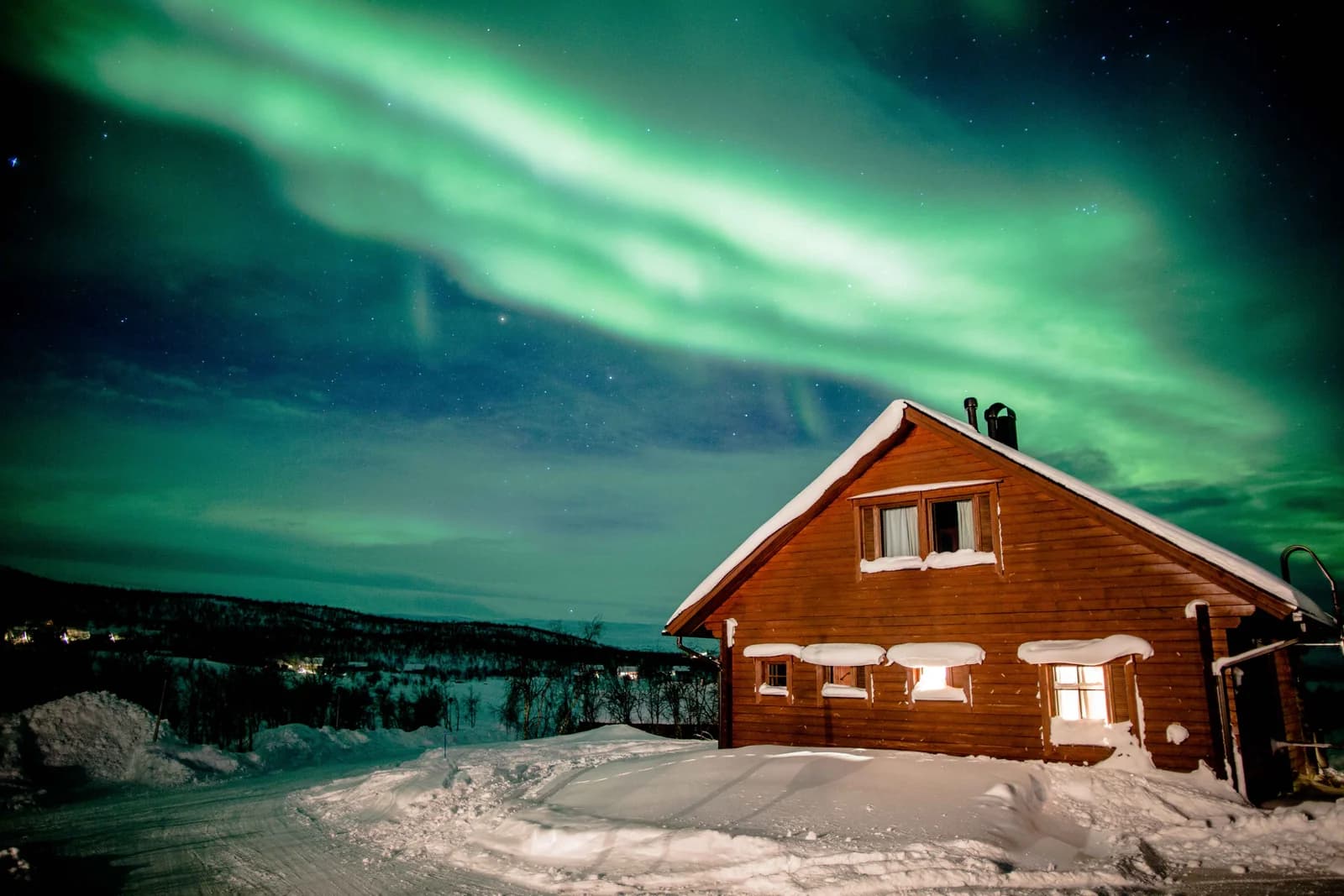
In Brief
Which month is best for Northern Lights in Finland?
March offers the strongest overall conditions for viewing the northern lights in Finland. Finnish Meteorological Institute pages highlight March alongside February or September and October. Combined NASA satellite cloud data and US Naval Observatory twilight tables confirm March delivers 62 clear dark hours in Rovaniemi, surpassing December's 41 hours.
Key takeaways
- The Finnish Meteorological Institute calculates aurora on roughly 50 percent of dark, cloudless nights in Lapland resorts, rising to 75 percent at Kilpisjarvi.
- March and September provide roughly 50 percent more clear dark sky hours in Rovaniemi than midwinter months.
- Helsinki averages one aurora night per month, constrained by geomagnetic latitude rather than cloud cover.
- Finnish Lapland does not require an elevated Kp storm index because it sits directly along the auroral oval edge.
Pick your budget
Budget
Town center hotels near public transit
Rovaniemi city center base
Standard lodging near the railway station and local bus connections, avoiding airport shuttle costs and keeping dining within walking distance.
- Most popular
Mid-range
Resort chalets and wilderness lodge rooms
Yllas or Saariselka resort area
Self-catering apartments or lodge rooms located in the 50 percent auroral zone, with trail access away from municipal street illumination.
Splurge
Countryside glass cabins and heated aurora view rooms
Out-of-town glass roof lodging
Heated glass roof accommodation positioned outside municipal lighting zones, with overnight sky observation directly from the bedroom.
Northern lights Finland: what the national met office actually publishes
The Finnish Meteorological Institute, known locally as Ilmatieteen laitos, publishes the country's official regional aurora probability ladder. Instead of publishing arbitrary night counts, the met office calculates the statistical probability of observing northern lights during a dark and cloudless night across distinct geographic zones. Their published data shows that at Kilpisjarvi in the far northwest, revontulet (the Finnish word for the northern lights) appear on approximately 75 percent of dark, clear nights. Across Finnish Lapland, including the ski resorts of Yllas, Levi, and Saariselka, the frequency reaches roughly 50 percent of clear, dark nights.
Moving southward changes the odds significantly. In central Finland, covering areas such as Oulu and Kuusamo, the met office records occurrences on roughly 25 percent of dark and cloudless nights. Along the southern coast, including Helsinki and Turku, auroral displays appear only once in a month on average. At Sodankyla, situated 130 kilometers north of Rovaniemi, the met office notes that every second night is an auroral night, observing that Finland as a whole sits on the southern rim of the auroral oval.
Travelers should evaluate the denominator of these percentages carefully. Ilmatieteen laitos specifies on its own charts that these proportions represent only dark and cloudless nights, not total calendar nights. Furthermore, the met office notes that these statistics rest primarily on 1990s aurora observations and acknowledges that between 2006 and 2009, during an extended period of low solar activity, Kilpisjarvi dropped to seeing aurora on roughly every second night. Common travel marketing claims of 200 aurora nights per year are published by neither the national met office nor the Sodankyla Geophysical Observatory.
- Met office regional probability on dark, clear nights: 75 percent at Kilpisjarvi, roughly 50 percent in Lapland resorts, 25 percent in central Finland, and once monthly in Helsinki.
- Probabilities apply strictly to dark and cloudless nights, not total calendar nights across the season.
- Finland lies on the southern rim of the auroral oval, requiring stronger solar activity for southern sightings.
- The widely circulated claim of 200 aurora nights per year is not published by any Finnish scientific institute.
The catch: The Finnish Meteorological Institute publishes no standalone aurora percentage for Rovaniemi itself, requiring visitors to look at Sodankyla to the north or Oulu to the south.
Best time to see northern lights in Finland, month by month
Official publications from the Finnish Meteorological Institute present two distinct assessments of peak viewing periods. One met office page indicates that the best time to see auroras is between 9 p.m. and 1 a.m. local time, identifying February to March and September to October as the best months. A second page on the same met office domain states that, considering also the weather, the best time for seeing auroras in Northern Finland is in March and early April. Both scientific evaluations point travelers away from midwinter holidays.
Astronomical tables and satellite metrics explain why shoulder months outperform midwinter. According to US Naval Observatory calculations for Rovaniemi on the 15th of each month, usable darkness spans 9 hours 2 minutes in September, 12 hours 38 minutes in October, 15 hours 57 minutes in November, 17 hours 58 minutes in December, 16 hours 59 minutes in January, 13 hours 56 minutes in February, and 10 hours 39 minutes in March. While December maximizes raw darkness, NASA POWER satellite cloud records show Rovaniemi averages only 2.3 clear window nights in December compared to 6.6 in September and 5.8 in March.
Multiplying monthly clear window nights by hours of real darkness on the 15th generates an index of clear dark hours: 60 hours in September, 42 in October, 40 in November, 41 in December, 41 in January, 42 in February, and 62 in March. September and March deliver about fifty percent more clear dark viewing sky than December. For visitors seeking winter activities alongside the lights, met office climate normals record median snow depth at Rovaniemi airport rising from 28 centimeters on December 15 to 77 centimeters on March 15.
- Clear dark sky hours in Rovaniemi reach 62 in March and 60 in September, compared to just 41 in December.
- NASA POWER satellite records show Rovaniemi averages 2.3 clear window nights in December versus 5.8 in March.
- US Naval Observatory data records 17 hours 58 minutes of darkness on December 15 in Rovaniemi, dropping to 10 hours 39 minutes by March 15.
- Met office normals show median snow depth at Rovaniemi airport reaches 77 centimeters in mid-March, compared to 28 centimeters in mid-December.
The catch: During summer months auroral observation is entirely impossible across Finland due to light nights, with Sodankyla Geophysical Observatory tracking season cutoff when the sun fails to drop 10 degrees below the horizon.
Where to see northern lights in Finland: the two ladders that run opposite ways
Choosing an aurora base in Finland involves balancing satellite cloud coverage against geomagnetic latitude. Across nineteen seasons of NASA POWER hourly satellite observations, Rovaniemi records 25.9 clear window nights per season (defined as at least two consecutive night hours below 25 percent cloud cover). In contrast, the one-degree grid cell covering Levi, Kittila village, and Yllas records 20.5 clear window nights, Luosto registers 19.8, the cell covering Saariselka, Ivalo, and Inari village yields 17.5, and Kilpisjarvi drops to 5.6.
The Finnish Meteorological Institute's aurora frequency ladder runs in the complete opposite direction. Kilpisjarvi occupies the top position with aurora on 75 percent of dark, clear nights, while Levi, Yllas, and Saariselka sit at roughly 50 percent. Rovaniemi sits south of the 50 percent mark, with Sodankyla Geophysical Observatory measuring the corrected geomagnetic latitude of its station 30 kilometers north of Rovaniemi at 63.6 degrees North.
This divergence creates a direct operational choice. Kilpisjarvi delivers the highest statistical probability of an auroral display whenever skies are clear, but suffers the most overcast skies in Finland due to its Scandinavian mountain terrain. Because NASA's satellite observations operate on a one-degree grid, Kittila, Levi, and Yllas share identical satellite data, as do Saariselka, Ivalo, and Inari, giving eight major base towns five unique cloud measurements.
- Rovaniemi leads Finnish Arctic bases with 25.9 clear window nights per season on NASA POWER records.
- Resort bases in Kittila and Yllas average 20.5 clear nights, while Saariselka, Ivalo, and Inari average 17.5.
- Kilpisjarvi records the lowest clear sky frequency at 5.6 clear window nights per season.
- The met office regional aurora frequency ladder places Kilpisjarvi highest at 75 percent and resort areas at 50 percent.
The catch: Kilpisjarvi averages only 0.5 clear window nights during the entire month of December, making a short four-night holiday stay statistically improbable to encounter clear skies.
Finland aurora season: when it opens, when it closes, and what kaamos is
Tourism agency Visit Rovaniemi defines the Lapland northern lights viewing season as running from late August until early April. Sodankyla Geophysical Observatory at the University of Oulu confirms this operational window using an objective physical threshold: the aurora observation season begins when the lowest nocturnal solar elevation dips 10 degrees or more below the horizon, and concludes in late April when night skies become too bright.
Visitors arriving in midwinter will encounter kaamos, the Finnish term for polar night when the sun remains entirely below the horizon. According to the Finnish Meteorological Institute, day length at the Arctic Circle never drops to zero, meaning true kaamos occurs only about half a degree of latitude north of the Arctic Circle. US Naval Observatory calculations show Rovaniemi and Luosto experience 0 days of polar night, with Rovaniemi receiving 2 hours 14 minutes of sunlight on the winter solstice.
North of the Arctic Circle, US Naval Observatory data reveals a escalating polar night ladder: Yllas experiences 14 consecutive polar night days (December 15 to December 28), Kittila village 16 days, Levi 20 days (December 12 to December 31), Saariselka 32 days, Ivalo 36 days, Inari village 40 days, and Kilpisjarvi 42 days (December 1 to January 11). Helsinki experiences no polar night, retaining 5 hours 53 minutes of daylight on December 15.
- The scientific aurora season begins in late August when the sun drops 10 degrees below the horizon and ends in late April.
- Kaamos represents the true polar night where the sun never rises, occurring only north of the Arctic Circle.
- Rovaniemi and Luosto experience zero days of polar night, retaining over two hours of daylight on the winter solstice.
- Polar night durations range from 14 days in Yllas to 42 continuous days in Kilpisjarvi.
The catch: Polar night does not provide an auroral viewing advantage, as towns with the longest kaamos periods correspond to those with the fewest clear night hours on satellite records.
Northern lights Helsinki: why the capital is a poor bet, in the met office's own numbers
The Finnish Meteorological Institute places Helsinki and Turku on the south coast at an average aurora frequency of once in a month. This reduced probability leads many travelers to assume southern Finland suffers from persistent cloud cover, but comparative satellite data reveals otherwise. NASA POWER hourly observations show Helsinki averages 28.4 clear window nights per season between September and March, exceeding Rovaniemi's 25.9 nights.
Darkness availability in the capital is also substantial. US Naval Observatory records show civil twilight (the period when the sun is below the horizon but the sky remains too bright for stars or auroras) leaves Helsinki with 16 hours 11 minutes of usable nocturnal darkness on December 15, trailing Rovaniemi's 17 hours 58 minutes by under two hours. The primary barrier to viewing auroras in Helsinki is entirely geomagnetic.
Because Finland lies on the southern rim of the auroral oval, auroral light over Helsinki requires a severe geomagnetic disturbance to push the oval equatorward. Ilmatieteen laitos notes that solar cycle intensity strongly dictates aurora frequency in southern Finland, whereas Lapland experiences consistent activity across all years. The met office associates visible auroral displays in southern Finland with a planetary Kp index of 5 or higher.
- Helsinki averages one aurora occurrence per month according to met office probability tables.
- NASA satellite records demonstrate Helsinki has more clear window nights (28.4) per season than Rovaniemi (25.9).
- December 15 darkness spans 16 hours 11 minutes in Helsinki, compared to 17 hours 58 minutes at the Arctic Circle.
- Southern Finland requires an elevated geomagnetic storm of Kp 5 or higher to push the auroral oval over the coast.
The catch: Watching for northern lights during a short stopover in Helsinki represents an unreliable gamble on severe geomagnetic storms, despite favorable clear sky counts.
What time of night should you go outside?
The Finnish Meteorological Institute states that the best time to see auroras is between 9 p.m. and 1 a.m. local time. In separate guidance, the institute notes that typical displays center around midnight, and a couple of hours before and after, while acknowledging that auroral emissions can occur randomly whenever skies are sufficiently dark.
Detailed Finnish-language research published by the met office outlines the precise hourly distribution. In Finnish winter time, the average probability of aurora occurrence in Lapland exceeds 50 percent starting at 21:00. Activity reaches its statistical peak around 23:30, corresponding to magnetic midnight when local perturbations in Earth's magnetic field reach maximum intensity. Toward the morning hours, activity declines steadily, dropping below 50 percent between 04:00 and 05:00.
This temporal curve directly impacts excursion planning. Guided evening bus excursions that conclude and return participants to town hotels at 22:00 cut off before magnetic midnight occurs. Met office viewing recommendations advise travelers to locate an open viewpoint facing an unobstructed northern horizon, eliminate local artificial lighting, and prepare for severe cold.
- Official met office guidance identifies 9 p.m. to 1 a.m. local time as the primary viewing window.
- Lapland aurora probability surpasses 50 percent at 21:00 and peaks at 23:30 during magnetic midnight.
- Occurrence rates decline after magnetic midnight, dropping back below 50 percent between 04:00 and 05:00.
- Excursions concluding before 22:00 miss the statistical peak of geomagnetic activity.
The catch: Remaining outdoors through magnetic midnight requires standing stationary during the coldest hours of the night, when ground temperatures drop to their daily minimums.
Do you need a big geomagnetic storm, and what is Kp anyway?
The planetary K-index (Kp) quantifies disturbances in the horizontal component of Earth's magnetic field on an integer scale from 0 to 9, where 1 indicates calm conditions and 5 or higher defines a geomagnetic storm. NOAA's Space Weather Prediction Center derives Kp as the mean standardized index from 13 geomagnetic observatories situated between 44 and 60 degrees geomagnetic latitude.
NOAA outlines an approximate physical relationship between Kp and the equatorward expansion of the auroral oval: at Kp 0, the southern edge of the oval rests near 66 degrees geomagnetic latitude, shifting equatorward by approximately 2 degrees for each incremental Kp level. Sodankyla Geophysical Observatory measures the corrected geomagnetic latitude of its station near Rovaniemi at 63.6 degrees North. Applying NOAA's rule of thumb indicates the auroral oval reaches Rovaniemi at low activity levels of roughly Kp 1 to 2.
Consequently, Finnish Lapland does not require a severe solar storm to produce visible displays. As NOAA notes, travelers positioned directly beneath the auroral oval can observe displays during quiet solar periods. The Finnish Meteorological Institute does not rely on the global Kp index for its domestic aurora nowcasting, using instead station-specific magnetic variation thresholds that alert sky watchers when local ground stations turn red.
- Kp measures magnetic field fluctuations from 0 to 9, with 5 marking the onset of geomagnetic storm conditions.
- At Kp 0, the auroral oval edge sits near 66 degrees geomagnetic latitude, expanding 2 degrees south per Kp step.
- Lapland bases sit under the oval edge at quiet levels of Kp 1 to 2, requiring no geomagnetic storm for visibility.
- The met office uses local magnetometer thresholds rather than Kp for its Finnish space weather nowcast service.
The catch: While Lapland requires minimal geomagnetic activity, southern Finnish destinations like Helsinki remain entirely dependent on major Kp 5 storm events to push displays south.
How cold it gets while you stand there waiting
Observing the northern lights in Finland requires enduring prolonged exposure during the coldest hours of the day. Finnish Meteorological Institute 1991 to 2020 climate normals record January mean monthly temperatures of -3.1 degrees Celsius at Helsinki Kaisaniemi, -8.2 degrees at Oulu airport, -10.3 degrees at Rovaniemi airport, -12.1 degrees at Saariselka, and -12.5 degrees at Sodankyla Tahtela.
Stationary night sky observation takes place at the daily minimum rather than the monthly mean. The met office records January mean daily minimum temperatures dropping to -13.5 degrees Celsius at Rovaniemi airport, -17.3 degrees at Kilpisjarvi village, -17.5 degrees at Sodankyla Tahtela, and -18.3 degrees at Utsjoki Kevo. Visit Rovaniemi publishes unverified marketing ranges citing January lows of -30 to -15 degrees, which sit substantially below the official met office 30-year normal minimum of -13.5 degrees.
Leaving populated settlements to escape urban illumination introduces an additional temperature drop. The met office operates two stations in Rovaniemi: the airport station and the rural Apukka station. In January, Apukka records a mean daily minimum of -17.0 degrees Celsius compared to -13.5 degrees at the airport, and in February records -17.2 degrees against -13.3 degrees. Escaping municipal light pollution adds an immediate 3.5 to 3.9 degree penalty to overnight watch conditions.
- Official January mean temperatures range from -3.1 degrees Celsius in Helsinki to -12.5 degrees at Sodankyla.
- Mean daily minimum temperatures in January reach -13.5 degrees at Rovaniemi airport and -17.5 degrees at Sodankyla.
- Rural stations like Apukka record nocturnal minimums 3.5 to 3.9 degrees colder than town airport weather stations.
- The met office notes that optimal dark, clear nights are practically always very cold in Finland.
The catch: The coldest winter conditions coincide directly with the clearer nights, forcing observers to endure sub-zero exposure to secure cloud-free viewing windows.
Getting from Helsinki to the aurora, and how far north you actually need to go
Long-haul visitors arriving from the United States, Singapore, or Australia will find no direct intercontinental air services into Finnish Lapland. Finavia, the state-owned operator of Finland's airport network, notes that Rovaniemi Airport is serviced by flights from major European cities alongside daily scheduled connections from Helsinki. Travelers must transit through Helsinki Airport or an alternative European hub before flying north.
For overland travel, VR (the Finnish state railway) operates daily sleeper services between Helsinki Central and Rovaniemi. In the published winter schedule, Train 265 departs Helsinki at 19:29 and arrives in Rovaniemi at 07:20, taking 11 hours 51 minutes. Train 273 departs at 23:04 and arrives at 10:58, taking 11 hours 54 minutes (with scheduled timetables prior to December 13, 2026 reflecting a 23:13 departure and 10:59 arrival). Upon arrival, Finavia places Santa Claus Village 3 kilometers from Rovaniemi Airport, while municipal measurements locate it 8 kilometers north of the city center.
Deciding how far north to travel is resolved by the met office frequency map. Moving from Helsinki (one night monthly) past central hubs like Oulu and Kuusamo (roughly 25 percent of clear nights) into Lapland doubles the observation rate to roughly 50 percent of dark, clear nights. Rovaniemi provides the practical logistical compromise: it maintains 25.9 clear window nights per season and frequent transport links, though bases further north gain higher raw geomagnetic frequency.
- Long-haul travelers reach Finnish Lapland by connecting through Helsinki or major European regional hubs.
- VR sleeper trains connect Helsinki to Rovaniemi overnight in 11 hours 51 minutes (Train 265) and 11 hours 54 minutes (Train 273).
- Aurora frequency increases from once monthly in Helsinki to 25 percent in Oulu and roughly 50 percent across Lapland.
- Rovaniemi pairs 25.9 clear window nights per season with direct rail and domestic flight connections.
The catch: Rovaniemi sits at 63.6 degrees North corrected geomagnetic latitude, giving it lower raw auroral occurrence odds than northern resort centers like Saariselka and Levi.
Planning factors for a Finnish aurora journey
Official agencies publish physical metrics for Finnish aurora viewing, including clear sky probabilities, daylight loss, and rail connections between Helsinki and Lapland.
| Item | Price | Source | Check prices |
|---|---|---|---|
| Train 265 overnight rail journey: Helsinki to Rovaniemi | 11 hours 51 minutes | Fintraffic Digitraffic scheduled winter timetable for VR train 265 | |
| Train 273 overnight rail journey: Helsinki to Rovaniemi | 11 hours 54 minutes | VR scheduled timetable from December 13, 2026 | |
| FMI aurora probability on dark, clear nights: Lapland ski resorts | Roughly 50% of nights | Finnish Meteorological Institute Auroras in Finland portal | Tours |
| FMI aurora probability on dark, clear nights: Kilpisjarvi | 75% of nights | Finnish Meteorological Institute Auroras in Finland portal | Tours |
| FMI aurora probability on dark, clear nights: Helsinki & Turku | Once a month on average | Finnish Meteorological Institute Auroras in Finland portal | Hotels |
Public meteorological and rail transit agencies establish these operational benchmarks. Aurora visibility requires both geomagnetic activity and clear skies.
Where to stay in Finland for northern lights
Base selections depend on the trade-off between cloud cover and geomagnetic latitude. Rovaniemi offers the highest clear window frequency among Finnish Arctic bases with 25.9 clear window nights per season and direct rail links from Helsinki, though the met office records higher raw aurora rates further north. Dedicated resort areas like Levi, Yllas, and Saariselka place visitors under a roughly 50 percent clear-night auroral probability zone while retaining established airport and transport infrastructure. Far northwestern bases like Kilpisjarvi attain a 75 percent clear-night auroral rate, but counter that advantage with only 5.6 clear window nights across the entire September to March season.
- Free cancellation on most rooms
- No booking fee
- Prices on Trip.com
How these facts were checked
Finnish Meteorological Institute climate normal publications, NASA POWER CERES SYN1deg cloud data, and US Naval Observatory solar position tables.
Finland: your questions
The questions people ask before booking.
Continue Planning Your Trip
Things to Do
Ranked attractions, tips and how to book tickets
Where to Stay
The best area to stay in each city, by neighborhood
Car Rental
Real prices, driving tips and the best routes by destination
Airport Transfers
Getting from the airport to your hotel, by price and time
All-Inclusive Guides
What all-inclusive really means, by destination
Best Time to Visit
Month-by-month weather, crowds and prices
Route Finder
Find the cheapest way to get there
Hotel Finder
Book the right hotel for your destination
AI Trip Planner
Build a day-by-day itinerary